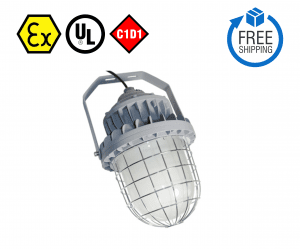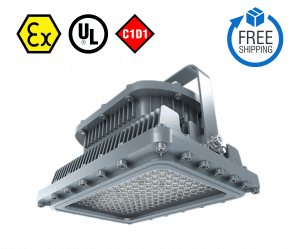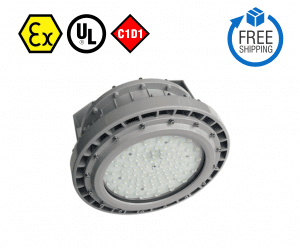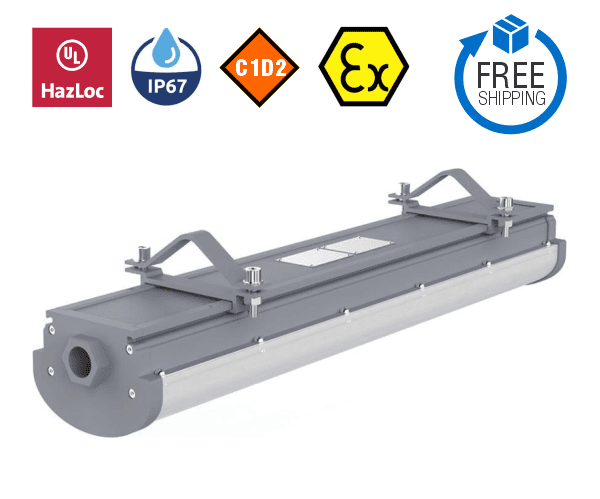
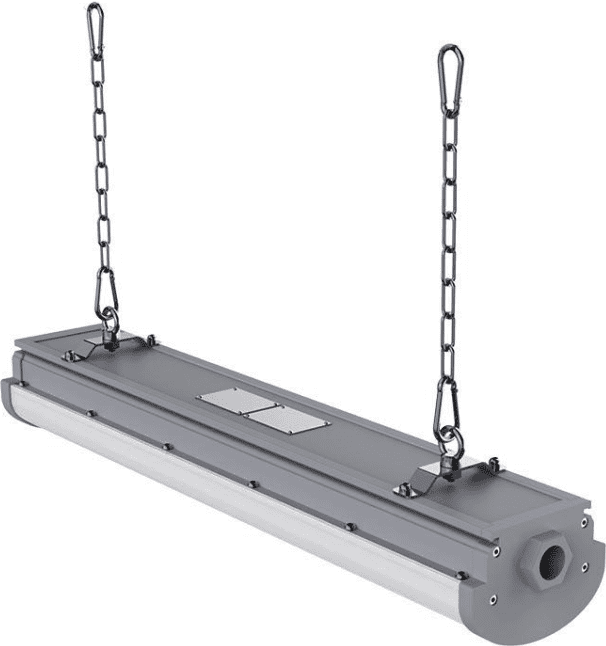
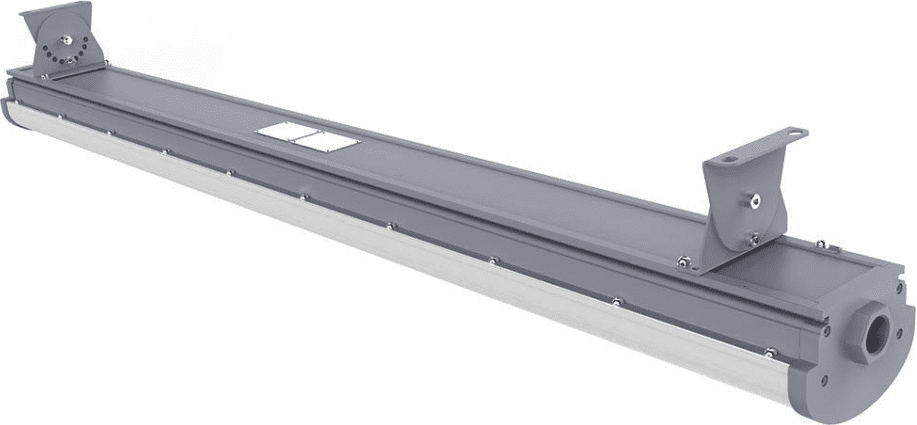
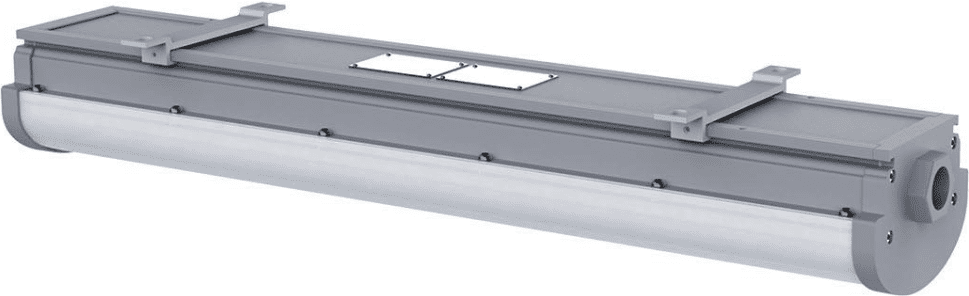
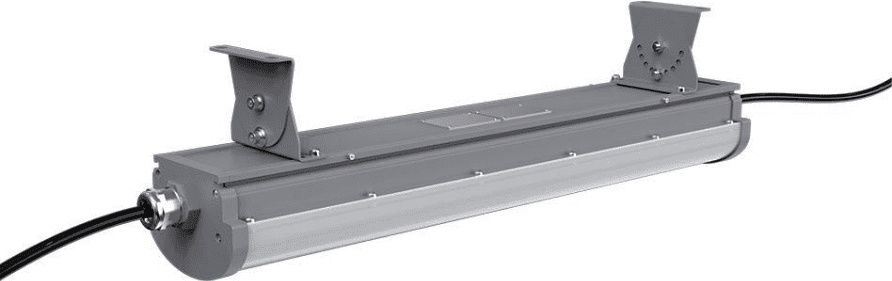

Description
FEATURES
- Patented designed to be curved fin shape, maximizes heat transmission.
- PC cover, excellent anti-corrosion performance, shock and vibration resistant, anti-glare, >90% light transmission.
- Replaces traditional explosion proof fluorescent lighting fixtures.
- LED: LM80 certified, 120-140lm/W, up to 14000 luminous flux.
- High efficiency LED driver, more than 50000 hours lifespan.
- Circuit design: 4KV/6KV surge protection power supply.
- Protection: IP66, high protection grade for waterproof and dust-proof applications.
- 5-year standard warranty
ATEX
- Ex II 2G Ex eb mb IIC T5 Gb
- Ex II 2D Ex tb IIIC T75°C Db
- IP66
- Certificate No: SEV 21 ATEX 0578 X
IECEx
- Ex eb mb IIC T5 Gb
- Ex tb IIIC T75°C Db
- I66
- Certificate No: IECEx SEV 21.0038X
Specifications
| Efficacy (Lm/W) | 120lm-140lm/W |
| Power | 40W / 60W / 70W / 80W / 100W |
| Voltage / Frequency | 12-24VDC/100-277VAC, 50-60Hz |
| Color Temperature | 3000K to 6500K available |
| CRI | >70 |
| Luminous Flus (lm) | 4800-72000 |
| Power Supply | High efficiency LED driver, more than 50,000 hours lifespan |
| Beam Angle | 120° |
| Power Factor | >0.95 |
| Rated Lifetime – L70 (hrs) | 50,000 |
| THD | <10% |
| Operating Temperature | -40° C to +50° |
| Entry Size | 3/4″ – 14 NPT or M25 X1.5 or M26X1.5 |
| Cable | Three-core rubber cable, IEC (CE) certification with 0.5m cable (standard) |

Download Product Cut Sheet
Knowledge Base
What is hazardous location lighting?
Hazardous location lighting is used specifically for areas that are hazardous locations. These light fixtures are designed so that there is less of a risk of the flammable vapors or gases present in the area causing a fire ignition.
What defines a hazardous area?
A hazardous area is a three-dimensional space in which an explosive atmosphere is or may be expected to be present or form. Electrical equipment within the hazardous area must be suitably rated and effectively earthed to ensure that any ignition risks are adequately controlled.
What is a Zone 1 hazardous area?
Zone 1: An area in which an explosive gas atmosphere is likely to occur in normal operation.
Zone 2: An area in which an explosive gas atmosphere is not likely to occur in normal operation and, if it occurs, will only exist for a short time.
What is ATEX Zone 1 certification?
Zone 1 – Explosive mixtures are present intermittently. Category 2 or 1 equipment required.
Zone 2 – Explosive mixtures are present abnormally or infrequently. Category 3, 2, or 1 equipment required.
What is explosion proof type?
Ex-Proof housing contains either cast aluminum or stainless steel, with sufficient mass and strength to subdue ignition, should flammable substances penetrate the internal electronics.
What makes a light explosion proof?
To be certified, explosion-proof lights typically will be made of durable, non-sparking material, a very thick glass globe over the bulb, and other features to ensure that the worker and the surrounding environment remains safe should an ignition occur inside the light.
Where can you use explosion proof lighting?
Hazardous Area/Explosion Proof lights are available for a wide variety of applications. Examples include linear wall/ceiling fixtures, flood lights, dock lights, high bay lights, wall packs and shop lights.
What class is explosion proof?
There are three classes of explosion proof lights known as Class I, Class II, and Class III. These are the broadest sense in which explosion proof lights are distinguished from each other. The classes are each broken down further into two separate divisions.
Is explosion proof the same as intrinsically safe?
Therefore, Intrinsically Safe means that an apparatus, such as a temperature transmitter is not capable of causing an explosion. Explosion Proof means that should an explosion occur, it will be contained within an enclosure.
What is the difference between ATEX and explosion proof?
ATEX and ex-proof classifications help manufacturers select and install equipment for potentially explosive atmospheres. ATEX is used in Europe, whereas Ex-Proof is used in North America and Canada. The process environment and properties of any materials that will be present need to be ascertained.
What is Class 1 Division 1 LED lighting?
Class 1 Div 1 LED Lighting (C1D1) is explosion-rated lighting designed to work in explosive environments where hazardous conditions and concentrations of flammable combustible vapors, liquids or gases, are always present. Class 1 Areas are defined as groups and are categorized by the type of material found.
What is class 1 luminaire?
Class 1 Division 1 LED lighting is used in industrial buildings to reduce the risk of high voltage equipment igniting flammable substances. Typical Class 1 Division 1 lights are designed to be explosion proof, making them suitable for exposure to these volatile chemicals.
What is a Class 1 Div 1 area?
A Class I, Division 1 area encompasses the combination of Zone 0 and Zone 1 areas. An area where ignitable concentrations of flammable gases, vapors or liquids are present continuously or for long periods of time under normal operating conditions.
Can you use Ex e in Zone 1?
Hazardous area Ex e isolators provide safe electrical isolation for low voltage power in Zone 1 & Zone 2 (gases) and Zone 21 & Zone 22 (dusts) explosive atmospheres.
What is Class 1 Division 2 LED lighting?
Class 1 Division 2 Lighting used in facilities that deal with flammable gases, vapors, and liquid materials. Additionally, the facility handling, processing, or using the materials in the defined hazardous location contain concentrations insufficient to be ignitable.
Does Class 2 Div 1 require explosion proof?
To meet the requirements for Division 2, a light does not have to be able to contain an explosion.
What are the requirements for Class 1 Div 2?
Class I Hazardous Locations refer to facilities which deal with flammable gases, vapors, and liquids. Division 2 specifies that these flammable materials are handled, processed, or used in the defined hazardous location, but are not normally present in concentrations high enough to be ignitable.
What is the difference between Class 1 Div 1 and Div 2?
Class I locations are ones in which hazardous vapors may or do exist. The difference between Div 1 and Div 2 is the level of expectation that hazardous levels will be present.